X:000 Y:000
+38 (098) 043-34-20 Telegram
SERVICES · DWG-241 · SERVICE 04 · SHEET METAL

Sheet metal: from model to a DXF that cuts without rework

Enclosures, cabinets, brackets, guards, retail fixtures. The model is built with Sheet Metal tools from the start, so the flat pattern comes out of it automatically — and matches what the press brake produces.

DXFfor laser
and plasma
Kfactor for
your press brake
8retail
structures
BOMgrouped by
thickness
WHEN YOU NEED IT

When you need sheet metal design

DWG-242
CASES
4

A bent sheet is often cheaper than a welded frame of the same size: fewer parts, less welding, less distortion afterwards. But only when the design was conceived for bending from the start, not translated from a tube frame.

The other typical case is a flat pattern made by eye or with someone else's calculator: after bending a flange comes out 1–2 mm long or short, and holes on mating parts no longer line up.

WHAT YOU RECEIVE

What you receive

DWG-243
OUTPUT
4 FILES
.DXFFlat patterns
for laser
.SLDPRTSheet Metal
model
.PDFDrawings
with bends
BOMNesting by
thickness

A 1:1 DXF of every part with the cut contour, holes and bend line marks on separate layers, so the laser operator can see what to cut and what only to mark.

Drawings with bend lines, direction, inside radius and operation sequence where it matters. The bill of materials is grouped by material and thickness, so you can see at a glance how much sheet of each gauge to order.

PROCESS

How I do it

DWG-244
METHOD
5 STEPS

The most accurate flat pattern is one calculated for specific equipment. So the first question is not “what to make” but “what will it be bent on”.

01

I confirm thicknesses, sheet grades and tooling: press brake die width, minimum radius

02

I build the parts with Sheet Metal tools using your shop's bend parameters

03

I check minimum flange lengths, hole distance from bend lines and corner relief cuts

04

I flatten every part and check it for self-intersection and fit on the sheet

05

I export DXF and drawings and group the bill of materials by thickness
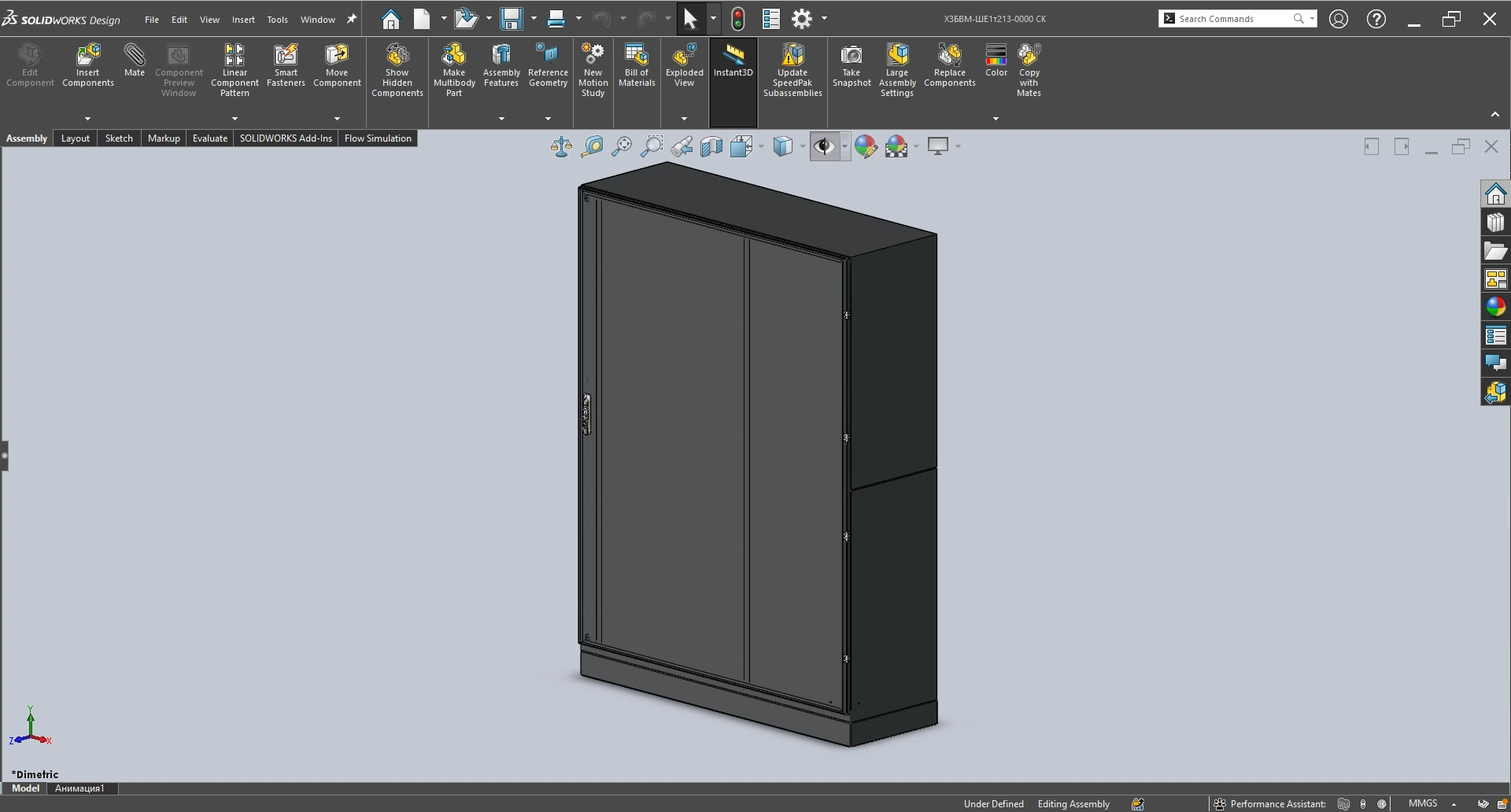
Electrical cabinet · sub-assembly Sheet metal electrical cabinet sub-assembly in SolidWorks with the feature tree visible
PRODUCTION CONSTRAINTS

Constraints the press brake sets

DWG-245
CONSTRAINTS
4 ITEMS

Sheet does not bend any way you like. The rules are simple, but breaking them is what scraps the first batch.

K-factor. It locates the neutral axis within the sheet thickness during bending. For steel it usually falls between 0.3 and 0.5 and depends on the die, the radius and the material itself. The most accurate source is your shop's bend table, or a test bend measured on the first part.

Minimum flange. A flange that is too short cannot be bent — it drops into the die. The minimum length depends on die width, which in turn is chosen for the sheet thickness.

Holes near bends. A hole closer than roughly two thicknesses plus the radius from a bend line stretches into an oval. Either the hole moves, or it is made after bending.

Inside radius. For ordinary structural steel a safe inside radius is at least the sheet thickness. For stainless and aluminium it is larger, or the outside face cracks.

EXAMPLES

Examples from practice

DWG-246
PROOF
4

In retail fixtures steel is counted in grams: the production run makes every extra kilogram visible in the budget, which is why bent sheet nearly always beats a welded frame there.

TIMING AND FORMAT

Timing and how we work

DWG-247
TERMS

A simple sheet metal part takes 3–5 days including DXF. An enclosure or cabinet with dozens of parts starts at a week. If you have your shop's bend table, send it with the task — the flat patterns will be right first time.

DXF files for parts that already exist in your model can be prepared separately, without full design work.

QUESTIONS

What people ask most

DWG-248
FAQ
4 Q
Yes. For sheet metal parts I issue a correct flat pattern accounting for K-factor and bend radii — the file goes straight to the laser without rework.
The one that matches your equipment. Without a bend table I use a typical value for the material and thickness and recommend a test bend on the first part.
Yes. AISI 304 where stainless is needed, AlMg3 when weight is critical. Each material has its own minimum radii and its own K-factor.
Often, and it cuts the part count and the welding. Not always, though: for heavy loads or long spans a tube section can be the better option. That becomes clear once the design is reviewed.
NEXT STEP

Related services

DWG-249
LINKS
3

Send a sketch or a model and tell me what it will be bent on — within 24 hours I will tell you how long it takes.

Discuss a part Message on Telegram